
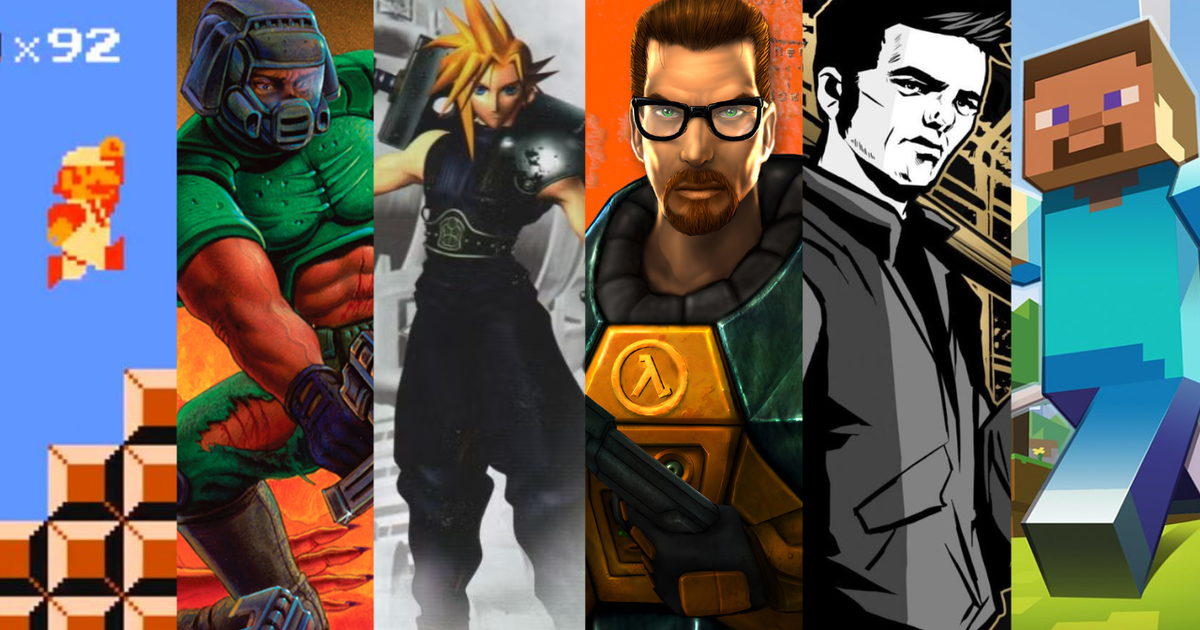
The history of video games is recorded by titles that not only won over millions of players, but also transformed the industry itself. Many of them distinguish themselves in a unique way, creating design standards, technology and business models that still influence modern video games today. These include classics such as Pong, which proved the commercial viability of games, Super Mario Bros., a benchmark in platform design, and The Legend of Zelda, which introduced non-linear exploration and open worlds. All of these works brought with them innovations that changed the concept of video games and the way they are seen.
After these pioneers, others played an equally decisive role: Tetris, with its simplicity that conquered the world; Doom, which popularized FPS and mod culture; Final Fantasy VII, which elevated narrative in RPGs; Half-Life, which integrated narrative and gameplay in an unprecedented way; Grand Theft Auto III, which redefined the three-dimensional open world concept; World of Warcraft, which consolidated the model of continuous services and persistent community; and Minecraft, which placed the player’s creativity at the heart of the experience. These 10 titles are pillars of the industry, each of them blazing trails that have influenced generations of games and creators.
In this article, we will explore a broader list of 45 video games that have forever shaped the industry, analyzing the impact of each one in different areas: technical innovation, gameplay design, narrative, open world and business models. For each game, we will explain how and why the sector changed, giving you a structured view of the evolution of video games from the first arcades to modern games that continue to set trends worldwide.
The 10 most influential games of all time
Before diving into the full list of 45 games, some titles stand out for having definitely influenced the industry, whether in technical terms, design, narrative or business model. These 10 games were not only popular, they also created standards that continue to this day.
Pong (1972) – The commercial birth of video games
- Platform: Arcade
- Impact: Pong was the industry’s first major commercial success. Its simple and accessible design showed that games could generate regular profits, paving the way for the creation of gaming arcades and companies specializing in games. Without Pong, the early industry and gaming culture of the 1970s likely would not have existed.
Ver no Youtube
Super Mario Bros. (1985) – The milestone of the industry’s recovery
- Plataforma: NES
- Impact: The release of Super Mario Bros. for the Nintendo Entertainment System (NES) it was a turning point after the great crisis of 1983. At the time, the North American console market was saturated with low quality games, which had led to a loss of consumer confidence and the collapse of several companies. Super Mario Bros. it offered a coherent, fun and technically refined experience, setting new standards in terms of level design, precise control and game feel. The title’s success not only boosted NES sales, but also restored credibility to the console industry, showing that carefully crafted games could win back the public and revitalize a market in crisis.
Ver no Youtube
The Legend of Zelda (1986) – The player’s freedom
- Plataforma: Famicom Disk System
- Impact: Introduced non-linear exploration, item-based progression, and persistent open worlds. Zelda proved that players could be active protagonists in the narrative, choose their path and explore freely. This model has influenced decades of RPGs and open-world adventures.
Ver no Youtube
Tetris (1984) – Simplicity and universality
- Platform: Multiplatform
- Impact: Tetris proved that a simple concept could win over audiences worldwide, overcoming cultural and age barriers. It popularized the puzzle genre and laid the foundations for mobile and educational games, as it managed to demonstrate that minimalist mechanics could generate infinite depth.
Ver no Youtube
Doom (1993) – The explosion of first-person shooters (FPS)
- Plataforma: PC
- Impact: Doom redefined the first-person shooter (FPS) genre, popularizing local multiplayer to encourage community modding. The game also introduced hardware-accelerated graphics and made FPS a cultural standard, creating a technical and social foundation that would influence the entire shooter industry.
Ver no Youtube
Final Fantasy VII (1997) – The global narrative RPG
- Plataforma: PlayStation
- Impact: Expanding the Japanese RPG to a worldwide audience, with a cinematic narrative, complex characters and adult themes. Final Fantasy VII elevated storytelling in video games, proving that AAA titles could thrill and engage players like interactive films.
Ver no Youtube
Half-Life (1998) – Integrated non-gameplay narrative
- Plataforma: PC
- Impact: Revolutionized storytelling in games. By integrating narrative directly into the action, without traditional cutscenes and with advanced artificial intelligence, Half-Life set the standard for modern FPSs that combine action and continuous narrative, inspiring games like Bioshock and Metro.
Ver no Youtube
Grand Theft Auto III (2001) – The modern open world
- Plataforma: PlayStation 2
- Impact: Redefined the concept of 3D sandboxing. GTA III offered complete freedom of urban exploration, varied missions and an adult narrative, creating the open world model that would influence virtually all modern sandbox franchises.
Ver no Youtube
World of Warcraft (2004) – The Continuing Service
- Plataforma: PC
- Impact: Established the MMO as a persistent service. With regular updates, endgame content and active communities, WoW demonstrated the potential of games as ongoing platforms, shaping the live-service model that dominates many AAA and free-to-play titles today.
Ver no Youtube
Minecraft (2011) – Creativity above rules
- Platform: Multiplatform
- Impact: A free sandbox, without fixed objectives, that puts the player’s creativity at the center of the experience. Minecraft has influenced open world design, educational games, and mass creative communities, proving that simple systems can generate infinite complexity.
Ver no Youtube
These 10 games can be considered pillars of the industry, each with an important dimension: commercial, technical, design, narrative, freedom or business model. They are the reference point for understanding the impact of all the other titles that follow in the list of 45 games.
Video Games That Influenced the Industry Forever
1. Technical and Technological Innovation
| Game | Again | Platform | Impact |
|---|---|---|---|
| Pong | 1972 | Arcade | First commercial success; proved that video games could generate steady profits and created the initial arcade culture. |
| Space Invaders | 1978 | Arcade | Popularized scoring and continuous challenge; it generated a large following in arcades and inspired later shooters. |
| Pac-Man | 1980 | Arcade | It introduced iconic characters and accessible gameplay, attracting audiences of all ages. |
| Tetris | 1984 | Multiplatform | It showed that a simple concept could win over audiences worldwide, influencing puzzle and mobile games. |
| Wolfenstein 3D | 1992 | PC | He founded the FPS genre, establishing a shooting and movement mechanic that would be a benchmark for decades. |
| Doom | 1993 | PC | It popularized FPS, LAN multiplayer, mods and shareware, creating a long-lasting technical and cultural ecosystem. |
| Quake | 1996 | PC | First FPS with a fully 3D engine; boosted eSports and online multiplayer games. |
| Crysis | 2007 | PC | Graphics benchmark that forced hardware evolution and optimization, influencing modern 3D engines. |
| Minecraft | 2011 | Multiplatform | An infinite sandbox world that promotes creativity, communities and educational games. |
| No Man’s Sky | 2016 | Multiplatform | Large-scale procedural generation; influenced discussions about technical innovation and the promise of games. |
2. Design e Gameplay
| Game | Again | Platform | Impact |
|---|---|---|---|
| Super Mario Bros. | 1985 | NES | It set standards in terms of game feel, level design, and platforming, revitalizing the industry after the 1983 crash. |
| The Legend of Zelda | 1986 | NES | It introduced non-linear exploration, item progression, and player freedom in open worlds. |
| Metroid | 1986 | NES | It combined action and exploration, creating the Metroidvania genre and influencing modern adventure games. |
| Final Fantasy VII | 1997 | PlayStation | World-class RPG with a cinematic narrative and complex characters, elevating AAA storytelling. |
| Half-Life | 1998 | PC | Narrative integrated into gameplay, advanced AI and absence of cutscenes; redefined FPS and storytelling in games. |
| Metal Gear Solid | 1998 | PlayStation | Stealth with cinematic narrative; has influenced modern spy games and stealth mechanics. |
| Resident Evil | 1996 | PlayStation | It created modern survival horror, combining tension, limited resources and horror storytelling. |
| Braid | 2008 | Xbox 360 / PC | Time manipulation as a central mechanic; influenced the design of innovative puzzles and indie games. |
| Limbo | 2010 | Multiplatform | Aesthetic minimalism and environmental narrative; a benchmark for artistic and indie games. |
| Dark Souls | 2011 | Multiplatform | Difficulty as intelligent design, well-defined risk and reward; created the “souls-like” genre. |
3. Narrative and storytelling
| Game | Again | Platform | Impact |
|---|---|---|---|
| Chrono Trigger | 1995 | SNES | Non-linear narrative and multiple endings; influenced the complex narrative in RPGs. |
| Planescape: Torment | 1999 | PC | Deep dialogues and an immersive world; redefined storytelling in Western RPGs. |
| Bioshock | 2007 | Multiplatform | Narrative and morality integrated into gameplay; a reference for narrative games. |
| The Last of Us | 2013 | PlayStation | Complex characters and emotional narrative; raised the level of storytelling in AAA. |
| Red Dead Redemption 2 | 2018 | Multiplatform | Realistic open world with an epic narrative; combines exploration, drama and minute details. |
| Undertale | 2015 | PC | It goes beyond the limits imposed by games, has innovative mechanics and an interactive narrative; big indie impact. |
| Persona 5 | 2016 | PlayStation | Combination of JRPG with social life simulation; narrative integrated into daily activities. |
4. Open World / Sandbox and Business Models
| Game | Again | Platform | Impact |
|---|---|---|---|
| Grand Theft Auto III | 2001 | PS2 | You redefined the open-world 3D sandbox; freedom of urban exploration and adult narrative. |
| Morrowind | 2002 | PC | Deep open world; total freedom to explore and create characters. |
| The Sims | 2000 | PC | Free social simulation; Games without fixed objectives can be very popular. |
| Assassin’s Creed | 2007 | Multiplatform | History, parkour and a detailed historical world; a benchmark for sandbox narrative exploration. |
| Minecraft | 2011 | Multiplatform | Absolute sandbox; player freedom and creativity at the center of the experience. |
| The Legend of Zelda: Breath of the Wild | 2017 | Switch | A modern open world with realistic physics, surprising exploration and unprecedented freedom. |
| World of Warcraft | 2004 | PC | Consolidation of the MMO as a persistent service; active community and constant updates. |
| League of Legends | 2009 | PC | MOBA and free-to-play; Consolidated eSports and competitive models at a global level. |
| Fortnite | 2017 | Multiplatform | Live-service, multiplatforms and microtransactions; redefined gamer culture. |
| Pokémon GO | 2016 | Mobile | Augmented reality and social interaction; expanded the casual audience worldwide. |
| Counter-Strike | 1999 | PC | Competitive multiplayer, mods and community; shaped modern competitive FPS. |
| Team Fortress 2 | 2007 | PC | Free-to-play with internal item economy; influences community design and monetization. |
Source: https://www.eurogamer.pt/os-jogos-que-influenciaram-a-industria-para-sempre